PurpleAir Analysis (January 1-25, 2026)
Data Acquisition
Data Source
- Platform: PurpleAir Community Sensor Network
- Sensor Model: Plantower PMS5003/PMS6003 optical particle counters
- Data Format: CSV files with 60-minute averages
- Access Method: Direct CSV download from PurpleAir website
Data Characteristics
- Total Sensors: 279 sensors in master sensor list
- Spatial Distribution: Dense urban coverage, with sensors distributed across residential, commercial, and institutional locations
- Temporal Coverage: January 1-25, 2026 (60-minute averages)
- Valid Sensors Processed: 254 sensors with valid data after quality control (91.0% data completeness)
- Sensors Filtered: 25 sensors removed due to outlier values >500 µg/m³ might be due to sensor errors or maintenance issues.
Quality Assurance
- Correction Formula: Applied University of Utah Winter Inversion correction:
Corrected PM2.5 = (0.778 × Raw_CF1) + 2.65 - Outlier Filtering: Removed sensor readings >500 µg/m³ (physically impossible for ambient air, indicating hardware failure)
- Rationale: PurpleAir sensors are optical particle counters that tend to overestimate PM2.5 in high-humidity conditions. The correction formula was derived from co-location studies comparing PurpleAir sensors with EPA FRM monitors under Utah winter conditions.
Advantages
- High spatial density enables detailed neighborhood-level analysis
- Near real-time data availability
- Community-maintained network provides extensive coverage
- Enables spatial interpolation for continuous surface mapping
Limitations
- Requires calibration correction for accuracy
- Variable sensor maintenance quality
- Potential data gaps if sensors go offline
- Different temporal resolution (hourly) compared to EPA daily averages
Technical Methodology
Coordinate System Standardization
- Target CRS: Web Mercator (EPSG:3857)
- Rationale: Standard web mapping projection ensures accurate overlay on basemaps and compatibility with web visualization libraries
- Reprojection: All spatial data (census tracts, sensor locations) converted from WGS84 (EPSG:4326) to EPSG:3857
Data Correction
Correction Formula (University of Utah Winter Inversion):
Corrected PM2.5 = (0.778 × Raw_CF1) + 2.65
Rationale:
- PurpleAir sensors are optical particle counters that tend to overestimate PM2.5 in high-humidity conditions
- Winter inversions in Salt Lake Valley create high-humidity environments
- University of Utah researchers developed this correction formula specifically for Utah winter conditions
- Formula derived from co-location studies comparing PurpleAir sensors with EPA FRM monitors
Application:
- Applied to all raw sensor readings before aggregation
- Correction applied before any spatial analysis or visualization
Quality Assurance
Outlier Detection:
- Physical Impossibility Threshold: PM2.5 > 500 µg/m³
- Rationale: Ambient PM2.5 levels above 500 µg/m³ are physically impossible in urban environments
- Action: Automatically filtered as hardware sensor errors
- Impact: 25 sensors (9.0%) removed from analysis
Visualization Range:
- Color scale capped at 80 µg/m³ to prevent extreme outliers from dominating visualization
- Data preserved for analysis but visually constrained for clarity
Spatial Interpolation
Method: Inverse Distance Weighting (IDW) interpolation
Process:
- Input Data: Discrete PurpleAir sensor points with corrected PM2.5 values
- Grid Creation: 200×200 interpolation grid covering study area bounds
- Interpolation Method: Linear interpolation to create continuous PM2.5 surface
- Output: Continuous PM2.5 surface as 2D array for heatmap visualization
Spatial Clipping:
- Mask Layer: Census tract boundaries (merged union)
- Purpose: Restrict heatmap visualization to inhabited land areas only
- Result: Clean visualization without pollution data over water bodies, mountains, or uninhabited areas
Data Aggregation
- Temporal Aggregation: Mean PM2.5 per sensor across entire study period (January 1-25, 2026)
- Spatial Representation: Each sensor represented as single point with aggregated value
- Rationale: Enables interpolation between sensors while maintaining individual sensor accuracy
Visualization Approach
- Method: Continuous surface visualization via spatial interpolation
- Color Mapping: OrRd colormap (yellow = low, red = high PM2.5)
- Demographic Context: Side-by-side with census tract choropleth showing population distribution (separate maps for 65+ and 85+)
- Output: High-resolution static maps (300 DPI) and interactive web maps for both age groups
Deliverables
Static Visualizations
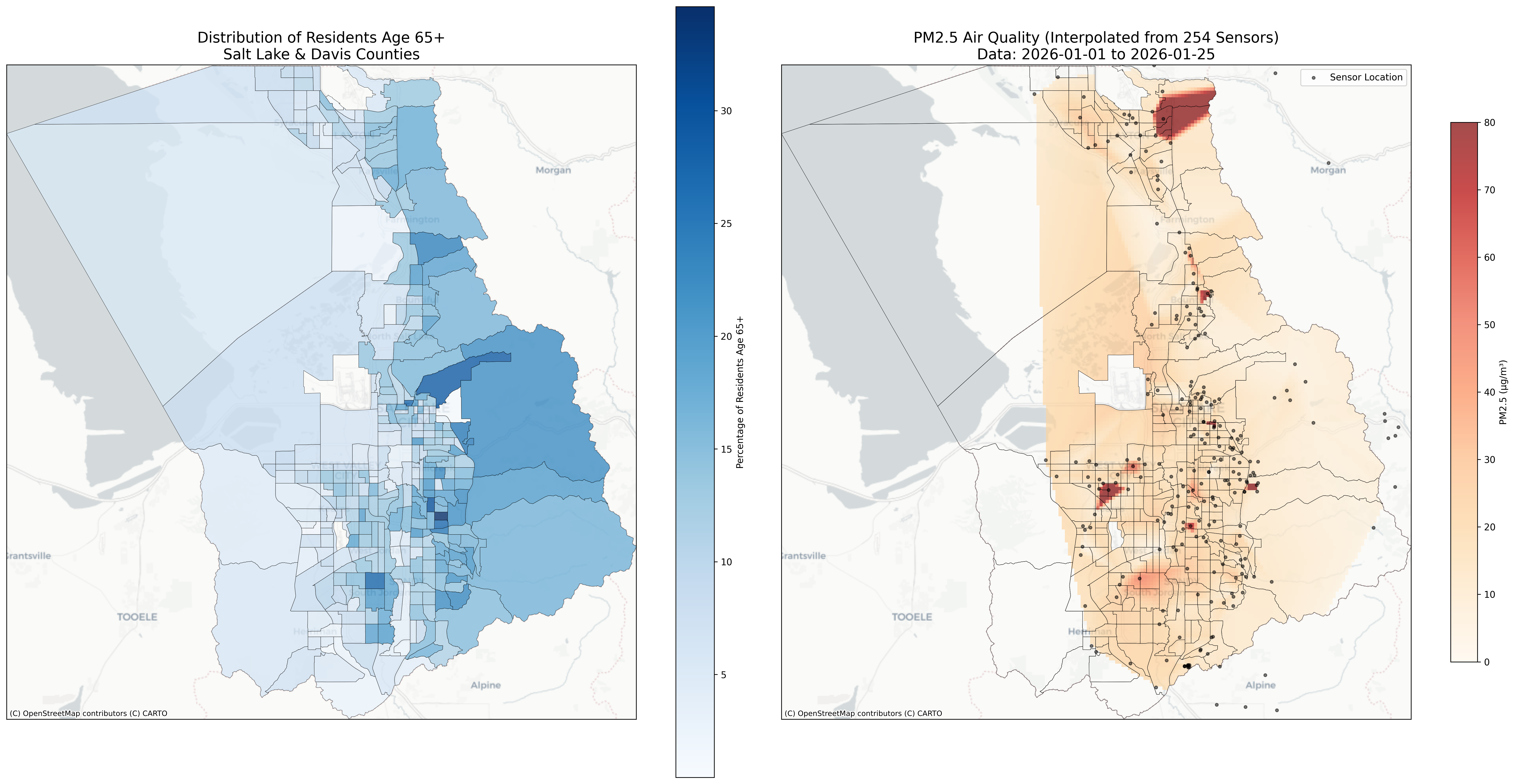
Population Age 65+ Map
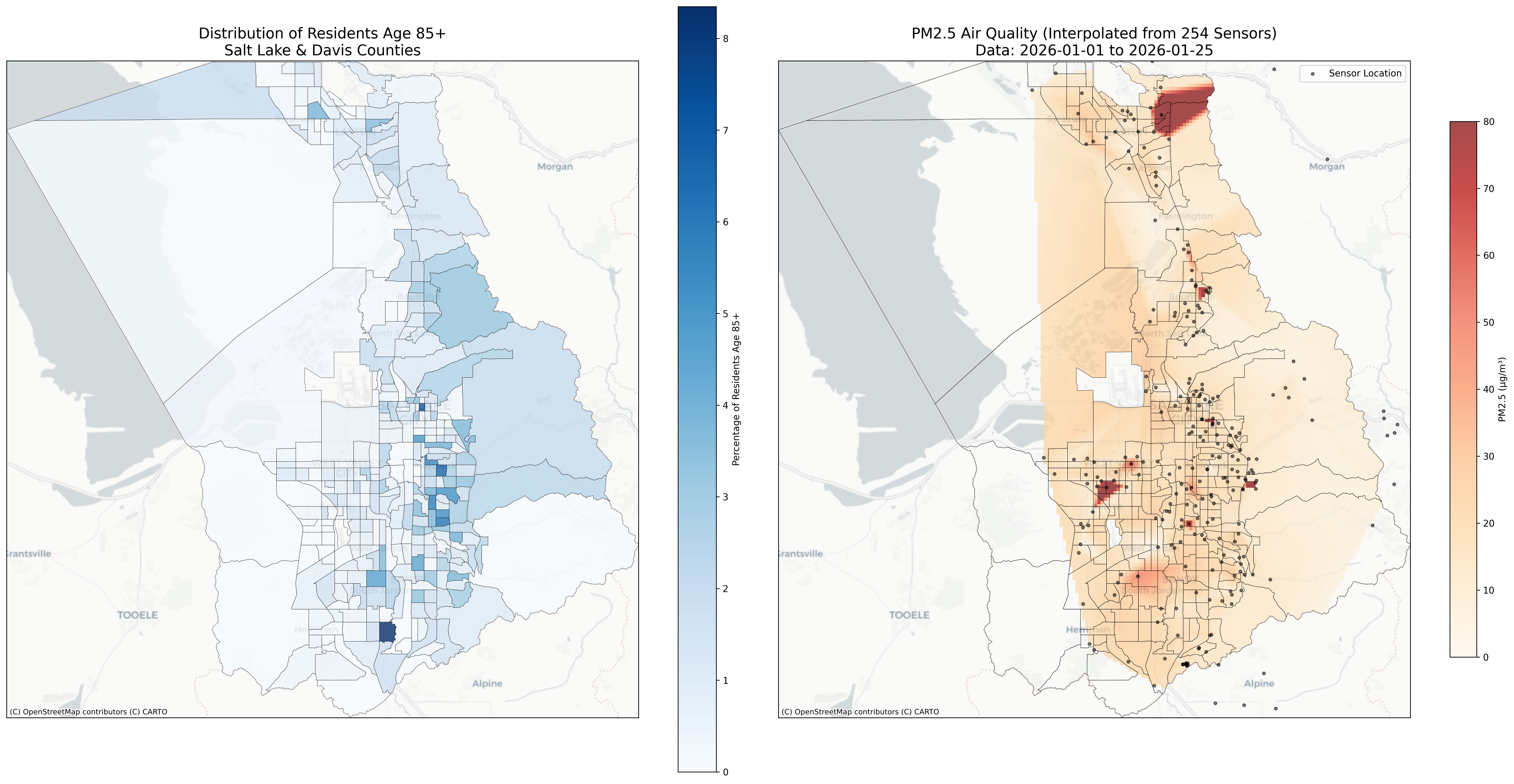
Population Age 85+ Map
Layout (for each age group):
- Left Panel: Choropleth map of Population Density
- Colormap: Blues (light = low, dark = high)
- Clearly shows concentration of seniors on East Bench and specific valley neighborhoods
- Legend: Population percentage per census tract
- Right Panel: PM2.5 Heatmap
- Interpolated surface from 254 PurpleAir sensors
- Colormap: OrRd (yellow = low, red = high)
- Sensor locations shown as black dots for transparency
- Spatial interpolation enables continuous surface mapping
Purpose: Demonstrate high-density sensor network capability for detailed neighborhood-level air quality visualization. Separate maps allow comparison between 65+ and 85+ population distributions and their spatial correlation with PM2.5 exposure patterns.
Data Analysis Plots
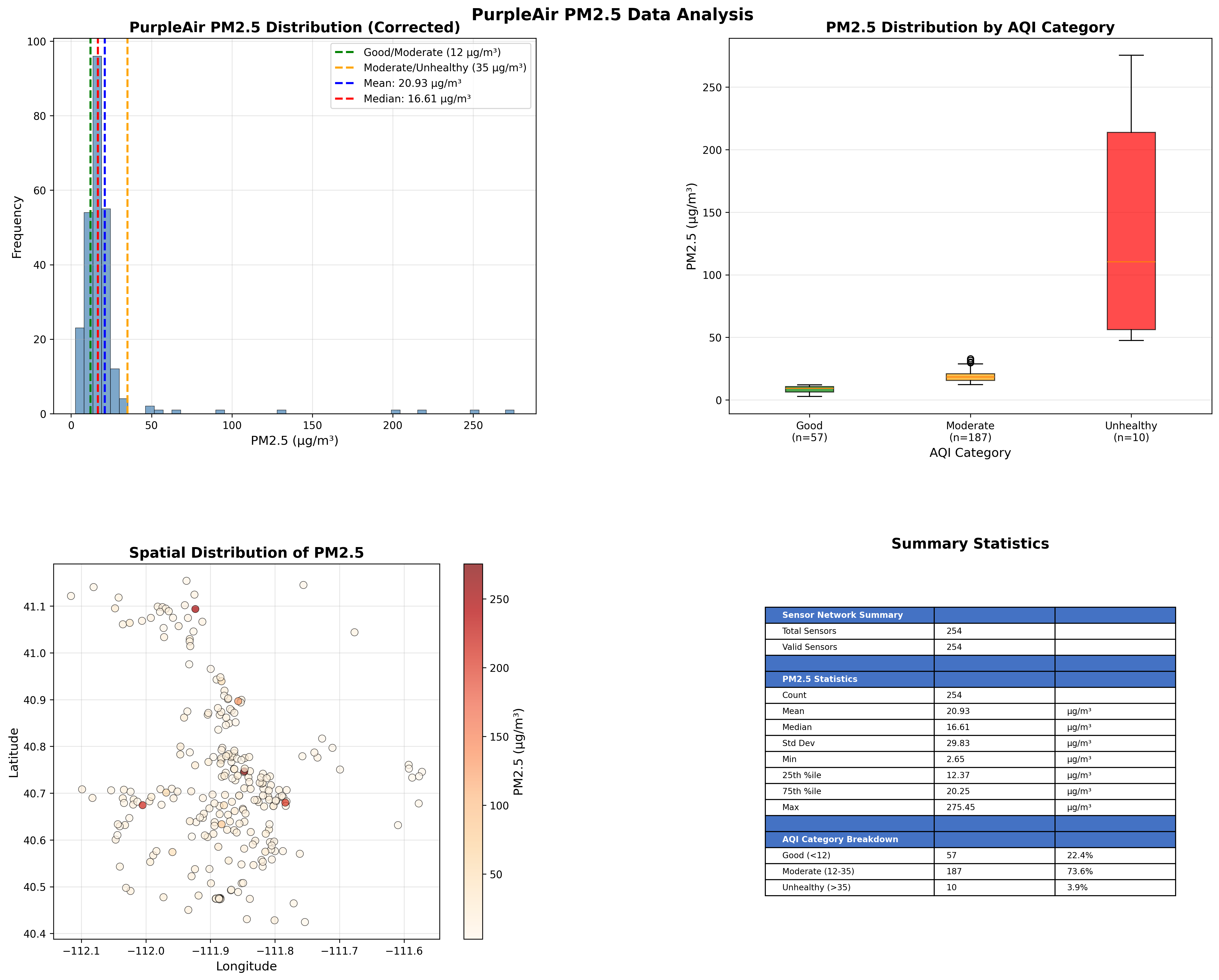
Content:
- Panel 1: PM2.5 Distribution Histogram (corrected values)
- Panel 2: Box Plot by AQI Category
- Panel 3: Spatial Distribution (Latitude vs. Longitude colored by PM2.5)
- Panel 4: Summary Statistics Table
Interactive Web Maps
Population Age 65+ Map
Interactive map - Click and drag to explore, use controls to toggle layers
Population Age 85+ Map
Interactive map - Click and drag to explore, use controls to toggle layers
- Choropleth layer for population demographics (toggleable)
- Circle markers for PurpleAir sensors (color-coded by PM2.5 level)
- Hover tooltips showing census tract information
- Clickable popups with detailed sensor information
- Layer control panel for toggling visibility
- Color-coded sensors by AQI category (Good/Moderate/Unhealthy)
- Legend with data period (January 1-25, 2026) and sensor counts
- Responsive design for desktop and mobile viewing
Key Findings
Air Quality Patterns
- Analysis Period: January 1-25, 2026
- Valid Sensors: 254 sensors with quality-controlled data
- Mean PM2.5: 20.93 µg/m³
- Median PM2.5: 16.61 µg/m³
- Range: 2.65 to 275.45 µg/m³
- Standard Deviation: 29.83 µg/m³
Air Quality Status Distribution
- Good (<12 µg/m³): 57 sensors (22.4%)
- Moderate (12-35 µg/m³): 187 sensors (73.6%)
- Unhealthy (>35 µg/m³): 10 sensors (3.9%)
Spatial Variation
- High-density sensor network reveals neighborhood-level variations
- Some areas show 2-3x PM2.5 differences between nearby neighborhoods
- Valley floor generally shows higher concentrations than bench areas
- Wide standard deviation (29.83 µg/m³) indicates significant spatial heterogeneity
Descriptive Statistics
Sensor Network Summary
- Analysis Period: January 1-25, 2026
- Total Sensor Files: 279
- Sensors in Master List: 279
- Valid Sensors Processed: 254 (after quality control)
- Sensors Filtered (Outliers >500 µg/m³): 25
PM2.5 Distribution Statistics (Corrected Values)
- Count: 254 sensors
- Mean PM2.5: 20.93 µg/m³
- Median PM2.5: 16.61 µg/m³
- Standard Deviation: 29.83 µg/m³
- Range: 2.65 to 275.45 µg/m³
- 25th Percentile: 12.37 µg/m³
- 75th Percentile: 20.25 µg/m³
AQI Category Breakdown
- Good (<12 µg/m³): 57 sensors (22.4%)
- Moderate (12-35 µg/m³): 187 sensors (73.6%)
- Unhealthy (>35 µg/m³): 10 sensors (3.9%)
Spatial Distribution
- Latitude Range: 40.4245° to 41.1540°
- Longitude Range: -112.1160° to -111.5722°
Observations:
- The wide standard deviation (29.83 µg/m³) indicates significant spatial heterogeneity in PM2.5 concentrations across the study area
- High spatial density enables capture of neighborhood-level variations not possible with sparse regulatory network
- Some sensors located in microenvironments with elevated concentrations contribute to the wide range
Data Quality Metrics
- Data Completeness: 91.0% (254 of 279 sensors with valid data)
- Outlier Filtering: 25 sensors (9.0%) filtered due to values >500 µg/m³
- Correction Applied: University of Utah Winter Inversion formula applied to all sensors
- Spatial Coverage: Dense urban coverage with sensors distributed across residential, commercial, and institutional locations
- Temporal Resolution: 60-minute averages (hourly data)
| ← Back to Home | View EPA Analysis → |